All Posts By

Kiply Lukan Yaworski

Bishop leads prayers at St. Front parish to install Fr. John Ezeoruonye as pastor

By Bishop Mark Hagemoen's blog

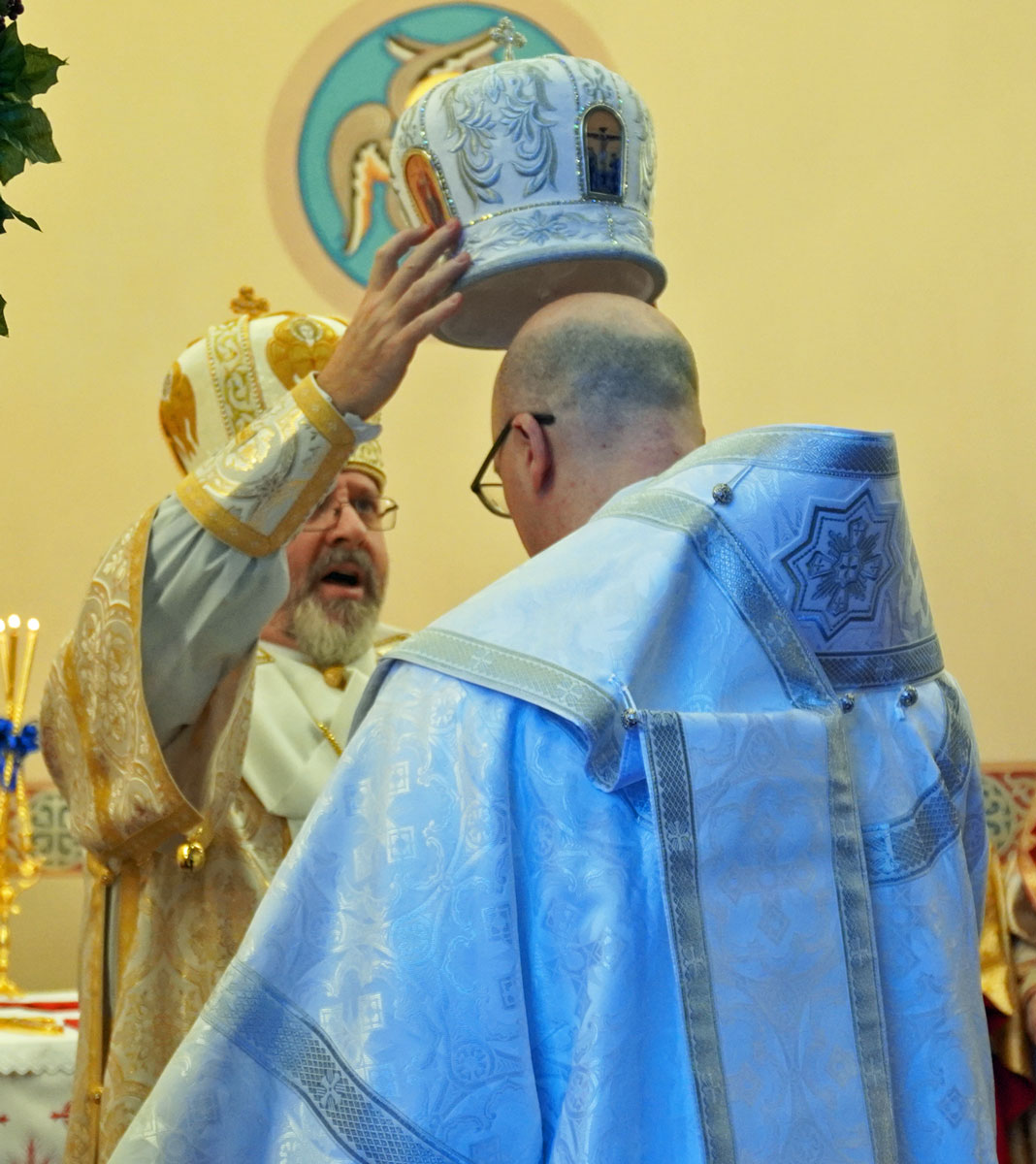
Bishop Mark Hagemoen led prayers for the installation of Fr. John Ezeoruonye as pastor of parishes at St. Front, Naicam, Rose Valley, Archerwill, and Nobleville, SK. (Photo by Jennifer Flasko)

Bishop Mark Hagemoen presided at Sunday Mass Nov. 5 at St. Front Parish in St. Front, SK, officially installing Fr. John Ezeoruonye as pastor of parishes at St. Front, Naicam, Rose Valley, Archerwill, and Nobleville, SK. (Photo by Jennifer Flasko)

Bishop Mark Hagemoen joined the faith community of St. Front Parish in St. Front, SK, Nov. 5, 2023 to celebrate the Eucharist and offer special prayers to officially install Fr. John Ezeoruonye as pastor.

Previously, Ezeoruonye served as associate pastor in the Humboldt area, before being posted this summer as the new pastor of St. Front and sister parishes of St. George, Naicam; Christ the King, Rose Valley; St. Felix, Archerwill; and St. Laurence, Nobleville.

The installation prayers offer an opportunity to reflect prayerfully on the role of the pastor, highlighting the priest’s sacramental ministry through a series of prayers at different spots throughout the church building: the altar, the ambo, the tabernacle, the baptismal font, the confessional, the entrance of the church, and so on.

Bishop Hagemoen will install other new pastors in parishes across the diocese in the weeks ahead, as his schedule permits (see schedule, below).

“This isn’t a required ritual, but it is something that is an option, and we have chosen to do that because of its simple but rich symbolism about the relationship of the pastor — the priest — with the people of God,” explains Bishop Hagemoen.

(Photo by Jennifer Flasko)

(Photo by Jennifer Flasko)


(Photo by Jennifer Flasko)


(Photo by Jennifer Flasko)

(Photo by Jennifer Flasko)

(Photo by Jennifer Flasko)

(Photo by Jennifer Flasko)


(Photo by Jennifer Flasko)


(Photo by Jennifer Flasko)

Other pastor installations by Bishop Hagemoen:

Upcoming:

  • Fr. Daniel Louh – St-Phillipe-Neri Parish, Vonda – Nov. 18, 2023 at 5:00 p.m.
  • Fr. Paul Oshin – St. Peter  Cathedral, Muenster – Nov. 19, 2023 at 9:00 a.m.
  • Fr. Daniel Yasinski – Our Lady of Lourdes, Saskatoon – Nov. 26, 2023 at 10:30 a.m.

More photos: LINK


CHAS convention panel: responding to the TRC Calls to Action

By Bishop Mark Hagemoen's blog

Bishop Mark Hagemeon welcomed CHAS convention participants to the Roman Catholic Diocese of Saskatoon and offered opening remarks at a public TRC panel discussion Oct. 26 at St. Philip Neri Parish.

Catholic Saskatoon News report: LINK

Chief Wilton Littlechild has a simple starting suggestion for advancing reconciliation: read the TRC Calls to Action, pick one that speaks to you, and take action right in your own circle.

Littlechild was a member of the national Truth and Reconciliation Commission that issued the 94 Calls to Action after a multi-year process of listening to Residential School Survivors and investigating the history of the Indian Residential School system in Canada.

“In reading those Calls to Action, listen to the one that speaks to you, then make a commitment to implement it, among yourself and your immediate circle of friends; with business confreres, or just within your own family,” suggested Littlechild. “Ask yourself: What can I do as an individual, or what can we do as a collective, to advance reconciliation?”

His suggestion came during a TRC panel public event organized as part of a two-day Catholic Health Association of Saskatchewan (CHAS) provincial convention Oct. 26-27 in Saskatoon. Littlechild spoke via telephone, after a last-minute flight cancellation derailed plans for him to attend the event in person.

Public event in Saskatoon

Held at St. Philip Neri Parish, with support from the parish Truth and Reconciliation Committee, the CHAS panel discussion also included Fr. Ken Thorson, OMI, of the Missionary Oblates of Mary Immaculate Lacombe Canada, Indigenous educator and Our Lady of Guadalupe parishioner Sandra Harper, and Regina Archbishop Donald Bolen.

As participants gathered for the event, Elder Gayle Weenie offered a smudge, before the evening opened with words of welcome from Peter Oliver, Executive Director of CHAS.

MC and program moderator Philomena Ojukwu of the CHAS board of directors led an opening prayer. (Photo by Kiply Lukan Yaworski)

MC and panel moderator Philomena Ojukwu of the CHAS board of directors presented a land acknowledgement, and led the gathering in an opening prayer, asking God to “guide all the people of our province in our mutual journey towards truth and reconciliation, help us to embrace the Calls to Action as an essential step toward healing and fullness of health.”

Bishop Mark Hagemeon welcomed convention participants to the Roman Catholic Diocese of Saskatoon and offered opening remarks. He noted that just a few days previously, he and others gathered for a Saskatchewan Catholic School Boards convention in Lloydminster were also able to meet and listen to Chief Wilton Littlechild, a member of Ermineskin Cree Nation who played a key role in the papal apology to Indigenous Peoples at Maskwacis, Alberta in July 2021.

“What came out of the sharing of Chief Littlechild was delight, surprise, and that God is doing great things – but not always in the way that we planned,” said Hagemoen. “Last week Chief Littlechild made it quite clear that this is a long-term journey, and he mentioned that many times. Long-term doesn’t mean we don’t move forward, it means that we don’t rush,” the bishop said, stressing the ministries of listening and presence.

Bishop Mark Hagemoen welcomed CHAS convention participants to the Roman Catholic Diocese of Saskatoon, and offered opening remarks. (Photo by Kiply Lukan Yaworski, Catholic Saskatoon News)

Hagemoen gave a brief summary of Indigenous ministry and the path of truth and reconciliation that has unfolded in recent years in the Roman Catholic Diocese of Saskatoon, pointing in particular to the work of Our Lady of Guadalupe Indigenous and Métis Catholic Parish in Saskatoon and the ongoing efforts of a Diocesan Council for Truth and Reconciliation (DCTR) established in 2012, as well as the recent establishment of an Indigenous Discernment Circle for local projects to be funded by the Indigenous Reconciliation Fund that is part of the national $30-million fund-raising commitment undertaken by the Canadian Catholic bishops. Hagemoen also stressed the important ongoing reconciliation efforts by Catholic health care and Catholic education in Saskatchewan.

Mario Fiddler introduced his children, who join him as part of the Cree Canaries family drum group. (Photo by Kiply Lukan Yaworski, Catholic Saskatoon News)

The Cree Canaries family drum group was on hand to perform a song of hope and healing. Before beginning the song, Mario Fiddler spoke about the power of forgiveness and the impact of sharing traditional drum and song, before introducing his children who join him in the group, which has been performing at a range of events for the past several years.

Panel presentations

Reflection question presented to panelists: “The TRC Commissioners define reconciliation as restoring respectful relationships. How would you recommend that the people listening this evening internalize, reflect, and respond to the Calls to Action specific to them as individuals and within their respective organizations?”

Panelist Fr. Ken Thorson, OMI, provided an overview of the history of Residential Schools and the involvement of the Catholic Church and the Missionary Oblates of Mary Immaculate, beginning with a scripture passage from Isaiah 46:9: “Remember the former things, those of long ago.”

“The schools were part of a structurally sinful system which was incapable of valuing – and was constructed to eradicate – Indigenous culture, religion and language,” he said, reviewing the history of Oblates and Indigenous peoples in Canada.

Fr. Ken Thorson, OMI, is the Provincial Superior of Oblate Lacombe Canada. (Photo by Kiply Lukan Yaworski, Catholic Saskatoon News)

A reflection at the time of the 150th anniversary of the arrival of the Missionary Oblates in Canada culminated in 1991 at Lac-Ste-Anne, Alberta, where the Oblate leadership delivered an apology for the abuse that happened in Residential Schools operated by the missionary order.

Thorson highlighted portions of the 1991 statement that apologized for the abuse that happened, and the very existence of the schools: “The biggest abuse was that the schools themselves happened, and that the family bond inherent in families was violated as a matter of policy.” In that apology the Oblates committed to collaborate with Indigenous peoples “so that the full story of residential schools might be written, and an effective healing process begun.”

That commitment includes sharing Oblate archival history in support of an effective healing process, he said.

Thorson briefly highlighted the impact of archival materials on the healing journey, as well as the Oblates’ ongoing effort to resolve historic abuse cases, and to make available personnel files of the Oblates who worked in the schools. Recently, the date of release of records after the death of an Oblate was reduced from 50 years to two years “to ensure as speedy access as possible by Indigenous communities to the history that may be contained in these files.”

The Oblates are also building on the historic visit of Pope Francis to Indigenous lands in Canada, Thorson said, as well as “listening from a humble place, listening more than talking… We have much yet to learn and much to do to reconcile, but we are committed to the journey.”

Chief Wilton Littlechild joined the event by telephone (held at the microphone by CHAS Executive Director Peter Oliver) after his flight to Saskatoon was cancelled after several delays. The former TRC Commissioner and residential school survivor encouraged participants to read the 94 TRC Calls to Action, choose one that speaks to them as an individual, and then take action. (Photo by Kiply Lukan Yaworski, Catholic Saskatoon News)

In his presentation via phone call, Chief Wilton Littlechild said he encourages everyone to read the Calls to Action. “It doesn’t take long to read them all,” he noted. “At the same time, I ask them to listen very carefully to the one that speaks to you as an individual…and then, make a commitment to yourself to implement that call.”

Littlechild also encouraged reading the United Nations Declaration of Rights of Indigenous Peoples which took the Canadian TRC principals of reconciliation and made them international. “Now the whole world, through the United Nations, is becoming aware of what reconciliation looks like globally.”

The TRC Calls to Action, the United Nations declaration, the calls for justice for Murdered and Missing Indigenous Women and Girls, and Treaties 1 to 11 in Canada all have common threads, he said; in particular “that we have to work together…that is the common message through all this work.”

Littlechild concluded with words in Cree, which he said were offered to his sisters and brothers in the spirit of reconciliation. “As we move forward together as a source of strength, we rely on our language and our spirituality,” he said.

Panel speaker Sandra Harper, educator and member of Our Lady of Guadalupe Indigenous Parish. (Photo by Kiply Lukan Yaworski, Catholic Saskatoon News)

In her presentation, panelist Sandra Harper focused on relationship, grounded in her identity as an Indigenous Catholic woman, the daughter of a Residential School survivor.

“I understand and I feel the effects that the schools have on people. So as such, I try to help and assist in any way I can those people who are in suffering stages, because they are stuck and don’t know what to do with themselves” Harper said.

“We are talking about the effects of Residential Schools and what they did to us as Indigenous people and that assimilation is a really important point… they wanted to take us and make us something that we are not. And that was a wrong, in so many ways and at so many levels,” she said. “There was no reflection about whether we were good enough, or whether we had things that were good enough. We were considered nobody.”

Sitting down together and having discussions and dialogue is vital, she stressed. “These are important things that need to happen for each and every one of us, at our parish level, at our community level, at our family level, all across the board, in order to come to some understanding of our shared history.”

“The truth of the matter was never shared from an Indigenous perspective, so I think as a teacher, my job and my role is to fulfill all those Calls to Action through educating others. So that means sitting with everybody and being part of the discussion. That will lead us to understanding and that will pave a road that we take together.”

Harper also reflected on the apology by Pope Francis and its importance. “He made people feel like they mattered. He validated the existence of Indigenous people and he said this Church was wrong and we as Indigenous people needed to hear that,” she said.

“The motto of truth and reconciliation is restoring respectful relationships. Well then, let’s do it. Lets get together and have a coffee and talk … it is every day when you walk down the street,” she said. “I think this is the time when we could get together, and come together as God’s people to find solutions for everyone.”

She noted how many teachings in the Indigenous world view are similar to the teachings of the Catholic Church. “But we never ever look at them, we never accept them as being valid, and we definitely never are given a chance to share them. And I think it is about time that we decided to do this in a respectful manner,” Harper said. “My God and your God are the same God. It is not different for me because I am Indigenous. It is all the same.”

Panel speaker Archbishop Donald Bolen of Regina. (Photo by Kiply Lukan Yaworski, Catholic Saskatoon News)

Archbishop Donald Bolen encouraged those in attendance to read and reflect on the messages of Pope Francis, delivered during his visit to Canada in July 2021.

“In addition to the encouragement to read the Calls to Action (and the United Nations Declaration on Indigenous Peoples), I would also encourage you to read the collective corpus of Pope Francis’ texts while he was here. It is not a long read – those texts were written as a whole” he said. “The pope didn’t come up with these on his own, there was of course, a long dialogue, that involved Canadian bishops, and Indigenous leaders and elders …. These are the fruits of that dialogue and of the pope’s very careful listening.”

A commitment to telling the truth is a starting point, Bolen said. “We lived with a distorted understanding of our history in this nation. We lived with a very reductionist way of telling the story of who we are as Canadians. The Truth and Reconciliation process brought us all back to school, and taught us that we were missing the experience of Indigenous people , we were missing the waves of suffering that were caused by colonization and by Residential Schools, the Sixties Scoop, the Indian Act, the whole series of events. And now we need to learn to tell our story more accurately and fully.”

He encouraged his listeners to become allies in the pursuit of justice –  to address ongoing and “pressing elements of systemic injustice in our society,” such as poverty, incarceration rates, addictions, suicide, access to health, and access to water. “The work of solidarity is the work of listening to Indigenous Peoples, engaging in dialogue, building relationships, finding out where there is injustice, and finding out how we can be in solidarity with that work,” Bolen said.

He echoed Pope Francis’ call to be advocates for Indigenous language, culture, and traditions, “because they are rich and they are beautiful and they have wisdom, and they were wrongly suppressed, and taken away,  and finding right relations means assisting in giving back what was lost.”

Finally, he called attention to the wisdom of Indigenous ways of living on the land, living with creation, and the Indigenous understanding that all is connected. “That is a vision, a way of seeing the world, to be learned from.”

“The whole visit of the pope was under the  banner of walking together,” Bolen said, noting the message written in a Quebec guest book by the Holy Father: “walking together is not easy, but it is possible.”

The CHAS truth and reconciliation panel event was open to the public Oct. 26, part of a two-day provincial convention for the Catholic Health Association of Saskatchewan. (Photo by Kiply Lukan Yaworski, Catholic Saskatoon News)


(Photo by Kiply Lukan Yaworski, Catholic Saskatoon News)


CHAS Convention 2023

The TRC panel was one part of a two-day CHAS convention, exploring the theme “Holistic Care: Healing Through Spirit, Story and Song.” Other convention sessions held at Queen’s House in Saskatoon included an opening keynote by Rev. David Maginley on near-death experiences, and a closing keynote on accompaniment and compassionate presence.

Other feature presentations included “Understanding the impact of Catholic health in Canada today” by John Ruetz, CEO of the Catholic Health Alliance of Canada, and a presentation by Anna Marie Vargas-Leveriza and Maricela Campa highlighting how to better respond to people experiencing a mental health crisis.

Convention breakout sessions addressed supporting people immigrating from Ukraine, by Fr. Ivan Nahachewsky, Vicar General and Chancellor of the Ukrainian Catholic Eparchy; the healing spirituality of St. Therese of Lisieux presented by Fr Kevin McGee, Vicar General of the Roman Catholic Diocese of Saskatoon; and providing holistic care for marginalized and high-risk populations, presented by Katelyn Roberts and Dr. Morris Markentin of Sanctum Care Inc.

The convention also included awards and an Annual General Meeting.


CHAS Executive Director Peter Oliver welcomed the crowd that gathered at St. Philip Neri Parish for the public event — part of a two-day annual convention of the Catholic Health Association of Saskatchewan. (Photo by Kiply Lukan Yaworski, Catholic Saskatoon News


-30-

United Conference held in Saskatoon

By Bishop Mark Hagemoen's blog

FacetoFace Ministries hosted its annual United Conference Oct. 28-29, 2023, at the Cathedral of the Holy Family in Saskatoon, with keynote speaker Dan DeMatte, Co-Founder of Damascus Ministries, bringing together some 352 participants for a weekend of growing in faith, sharing in sacraments and worship, and experiencing community.


(Photos by Felicity Dean, courtesy of FacetoFace Ministries)

(Photos by Felicity Dean, courtesy of FacetoFace Ministries)

Bishop Mark Hagemoen presided over Sunday mass at the Cathedral of the Holy Family on Oct. 29, addressing the United Conference participants who joined the parishioners and encouraging the youth to continue living out their faith.

Bishop Mark Hagemoen homily:


Video summary of UNITED 2023:


Mark your calendars for United Conference 2024 – October 26-27, 2024.  Stay tuned for more details and registration in Spring 2024.

For more information about the mission and work of FacetoFace Ministries, visit the website at f2f.ca.

-30-

Bishop leads prayers in Wilkie to officially install Fr. Rinesh Menambadath Chacko, VC, as pastor

By Bishop Mark Hagemoen's blog

Prayers related to the ministry of a priest were said at various locations around St. James Parish in WIlkie during Sunday Mass Oct. 22, as Bishop Mark Hagemoen officially installed Fr. Rinesh Menambadath Chacko, VC, as pastor. (Photo by Allison Bertoia)

Bishop Mark Hagemoen joined the faith community of St. James Parish in Wilkie, SK, Oct. 22, 2023 to celebrate the Eucharist and offer special prayers to officially install Fr. Rinesh Menambadath Chacko, VC, as pastor of the parishes at Wilkie, Handel, and Leipzig, SK.

The new pastor arrived in the Roman Catholic Diocese of Saskatoon in July.

The installation prayers offer an opportunity to reflect prayerfully on the role of the pastor, highlighting the priest’s sacramental ministry through a series of prayers at different spots throughout the church building: the altar, the ambo, the tabernacle, the baptismal font, the entrance of the church, and so on.

Bishop Hagemoen will travel to instal other new pastors in parishes across the diocese in the weeks ahead, as his schedule permits (see schedule, below).

“This isn’t a required ritual, but it is something that is an option, and we have chosen to do that because of its simple but rich symbolism about the relationship of the pastor — the priest — with the people of God,” explains Bishop Hagemoen.

The parish community of St. James, Wilkie, celebrated Mass with Bishop Mark Hagemoen Oct. 22. (Photo by Allison Bertoia)

Fr. Rinesh Menambadath Chacko, VC (Photo by Allison Bertoia)

(Photo by Allison Bertoia)

Prayers related to the ministry of a priest were said at various locations around St. James Parish in WIlkie during Sunday Mass Oct. 22, as Bishop Mark Hagemoen officially installed Fr. Rinesh Menambadath Chacko, VC, as pastor. (Photo by Allison Bertoia)

(Photo by Allison Bertoia)

(Photo by Allison Bertoia)

(Photo by Allison Bertoia)

Prayers related to the ministry of the priest were said at various locations around St. James Parish during Mass with Bishop Mark Hagemoen Oct. 22 at Wilkie. (Photo by Allison Bertoia)

Applause followed the special prayer ceremony officially installing Fr. Rinesh Menambadath Chacko, VC, as pastor. (Photo by Allison Bertoia)

Other pastor installations with Bishop Hagemoen presiding:

Upcoming:

  • Fr. John Ezeoruonye – St. Front Parish, St. Front – Nov. 5, 2023 at 11:00 a.m.
  • Fr. Daniel Louh – St-Phillipe-Neri Parish, Vonda – Nov. 18, 2023 at 5:00 p.m.
  • Fr. Paul Oshin – St. Peter  Cathedral, Muenster – Nov. 19, 2023 at 9:00 a.m.
  • Fr. Daniel Yasinski – Our Lady of Lourdes, Saskatoon – Nov. 26, 2023 at 10:30 a.m.

More photos:

Fr. Rinesh Menambadath Chacko, VC, is the new pastor at St. James Parish, Wilkie; St. Mary Parish, Handel; and St. Paschal Parish, Leipzig. (Photo by Allison Bertoia)

Presentation of the gifts during Mass Oct. 22 at St. James Parish, Wilkie, SK. (Photo by Allison Bertoia)

Celebration of the Eucharist Oct. 22 at St. James Parish, Wilkie, SK. Fr. Rinesh Menambadath Chacko, VC, is the new pastor at St. James Parish, Wilkie; St. Mary Parish, Handel; and St. Paschal Parish, Leipzig. (Photo by Allison Bertoia)

Fr. Rinesh Menambadath Chacko, VC (Photo by Allison Bertoia)

Fr. Rinesh Menambadath Chacko, VC, is the new pastor at St. James Parish, Wilkie; St. Mary Parish, Handel; and St. Paschal Parish, Leipzig. (Photo by Allison Bertoia)

Children prepare to play instruments during the recessional hymn of Mass Oct. 22 in Wilkie. (Photo by Allison Bertoia)

Fr. Rinesh Menambadath Chacko, VC,, is the new pastor at St. James Parish, Wilkie; St. Mary Parish, Handel; and St. Paschal Parish, Leipzig. (Photo by Allison Bertoia)

Bishop Mark Hagemoen joined the parish community of St. James, Wilkie, for Mass Oct. 22, officially installing Fr. Rinesh Menambadath Chacko, VC, as pastor at Wilkie, Handel and Leipzig. (Photo by Allison Bertoia)

St. James Parish choir leads music ministry during Oct. 22 celebration in Wilkie. (Photo by Allison Bertoia)

-30-

Bishop celebrates pastor installation of Fr. Santhosh Thekkekulam, VC, during celebration at Macklin parish

By Bishop Mark Hagemoen's blog

During celebration of the Eucharist Oct. 21 at St. Mary Parish in Macklin, Bishop Mark Hagemoen led prayers about priestly ministry during the official installation of Fr. Santhosh Thekkekulam, VC, as pastor of parishes at Macklin, St. Donatus, and Denzil. (Photo by Keith Kohlman)

By Kiply Lukan Yaworski, Catholic Saskatoon News

Photos by Keith Kohlman

Bishop Mark Hagemoen joined the faith community of St. Mary Parish in Macklin, SK, Oct. 21, 2023 to celebrate the Eucharist and offer special prayers to officially install Fr. Santhosh Thekkekulam, VC, as pastor of the parishes at Macklin, St. Donatus, and Macklin, SK.

Fr. Thekkekulam was appointed pastor of the Macklin-area parishes earlier this year. Previously, he served as pastor at Wilkie, Handel, and Leipzig.

The installation prayers offer an opportunity to reflect prayerfully on the role of the pastor, highlighting the priest’s sacramental ministry through a series of prayers at different spots throughout the church building: the altar, the ambo, the tabernacle, the baptismal font, the entrance of the church, and so on.

Bishop Hagemoen will travel to install other new pastors in parishes across the diocese in the weeks ahead, as his schedule permits (see schedule, below).

“This isn’t a required ritual, but it is something that is an option, and we have chosen to do that because of its simple but rich symbolism about the relationship of the pastor — the priest — with the people of God,” explains Bishop Hagemoen.

Prayers related to the ministry of the priest were said at various locations at St. Mary Parish in Macklin, as Bishop Mark Hagemoen installed Fr. Santhosh Thekkekulam, VC, as pastor of parishes at Macklin, St. Donatus, and Denzil. (Photo by Keith Kohlman)

Moving through the church building, saying prayers related to priestly ministry. (Photo by Keith Kohlman)

(Photo by Keith Kohlman)

(Photo by Keith Kohlman)

(Photo by Keith Kohlman)

(Photo by Keith Kohlman)

(Photo by Keith Kohlman)


Other pastor installations with Bishop Hagemoen presiding:

Upcoming:

  • Fr. John Ezeoruonye – St. Front Parish, St. Front – Nov. 5, 2023 at 11:00 a.m.
  • Fr. Daniel Louh – St-Phillipe-Neri Parish, Vonda – Nov. 18, 2023 at 5:00 p.m.
  • Fr. Paul Oshin – St. Peter  Cathedral, Muenster – Nov. 19, 2023 at 9:00 a.m.
  • Fr. Daniel Yasinski – Our Lady of Lourdes, Saskatoon – Nov. 26, 2023 at 10:30 a.m.


Bishop leads prayers for installation ofpastor at Allan, Colonsay, and Viscount

By Bishop Mark Hagemoen's blog

Bishop Mark Hagemoen joined the faith community of St. Aloysius Parish in Allan, SK, Oct. 8, 2023 to celebrate the Eucharist and offer special prayers to officially install Fr. Greg Smith-Windsor as pastor of the parishes at Allan, Colonsay, and Viscount, SK.

Ordained in 2015, Fr. Smith-Windsor previously served as pastor at parishes in Lanigan and LeRoy. He was appointed pastor of Allan, Colonsay, and Viscount, and associate pastor at Holy Spirit Parish in Saskatoon earlier this year.

The installation prayers offer an opportunity to reflect prayerfully on the role of the pastor, highlighting the priest’s sacramental ministry through a series of prayers at different spots throughout the church building: the altar, the ambo, the tabernacle, the baptismal font, the entrance of the church, and so on. Bishop Hagemoen plans to install other pastors in the diocese in the weeks ahead, as his schedule permits.

“This isn’t a required ritual, but it is something that is an option, and we have chosen to do that because of its simple but rich symbolism about the relationship of the pastor — the priest — with the people of God,” explains Bishop Hagemoen.

Bishop Mark Hagemoen led special prayers for the installation of Fr. Greg Smith-Windsor as pastor during Sunday Mass Oct. 8, 2023 at St. Aloysius, Allan, SK. (Photo by Adele Yanke)

(Photo by Adele Yanke)

(Photo by Adele Yanke)

(Photo by Adele Yanke)

Other upcoming pastor installations with Bishop Hagemoen presiding:

  • Fr. Santhosh Thekkekulam, VC– St. Mary Parish, Macklin – Oct. 21, 2023 at 7:00 p.m.
  • Fr. Rinesh Menambadath Chacko, VC – St. James Parish, Wilkie, Oct. 22, 2023 at 11:00 a.m.
  • Fr. John Ezeoruonye – St. Front Parish, St. Front – Nov. 5, 2023 at 11:00 a.m.
  • Fr. Daniel Louh – St-Phillipe-Neri Parish, Vonda – Nov. 18, 2023 at 5:00 p.m.
  • Fr. Paul Oshin – St. Peter  Cathedral, Muenster – Nov. 19, 2023 at 9:00 a.m.
  • Fr. Daniel Yasinski – Our Lady of Lourdes, Saskatoon – Nov. 26, 2023 at 10:30 a.m.

-30-

National Day for Truth and Reconciliation Sept. 30 – Message from Bishop Hagemoen

By Bishop Mark Hagemoen's blog

National Day for Truth and Reconciliation – Bishop Mark Hagemoen message – PDF

Dear Clergy, Religious, Parishes, PLDs, Parish Administration and Faithful of the Diocese of Saskatoon:

As we mark the National Day for Truth and Reconciliation this weekend, I wish to encourage all to take time for prayer, reflection, and solidarity with Indigenous Peoples.

On Sept. 30, we particularly remember and honour Residential School Survivors and those children who never returned home. This is a call for greater awareness and action that goes beyond the annual observance of “Orange Shirt Day.” Rather, it is a call for all of us to practically and continually work toward truth and reconciliation, acknowledging and striving to overcome the past mistakes, arrogance, and misuse of authority that has so often been part of our shared collective history. It is a call to move forward together in greater understanding, pursuing justice, and working for a better future for all.

I again renew my pledge that our diocese will continue to walk a path of reconciliation and healing. This is part of our gospel call to reconciliation and solidarity. We strive to walk in love and friendship as sisters and brothers, always working for justice, hope and healing. Let us all continue to take concrete steps on this journey.

Yours in Christ,

Most Rev. Mark Hagemoen

Bishop of Roman Catholic Diocese of Saskatoon

Canadian Conference of Catholic Bishops – National Day for Truth and Reconciliation 2023 message – English   |   French

Rock Your Roots Reconciliation Walk Sept. 30 in Saskatoon marked the National Day for Truth and Reconciliation. Among the participants were diocesan ministry leaders and Bishop Mark Hagemoen. (Photo by Andrea Alas, Diocese of Saskatoon Catholic Foundation)

Canadian Catholic bishops begin annual Plenary Assembly of the CCCB

By Bishop Mark Hagemoen's blog

(Submitted photo)

By CCCB Communications

The Plenary Assembly of the Canadian Conference of Catholic Bishops (CCCB) are gathering in King City, Ontario, for an annual meeting Sept. 25-28, bringing together 79 Catholic bishops from across the country to deliberate, discern, and discuss the life of the Church in Canada.

The first day of the 2023 Plenary Assembly of the CCCB included celebration of the Eucharist, a video presentation from Cardinal Tagle about a document related to reform of the Curia and the call for the Church to be missionary, a report from CCCB President Bishop Raymond Poisson highlighting the commitment to reconciliation with Indigenous Peoples and the Synod on Synodality, as well as reports related to the work of Development and Peace – Caritas Canada and World Youth Day.

Saskatoon Bishop Mark Hagemoen and Regina Archbishop Don Bolen (l-r) during a break in the 2023 Plenary Assembly meeting Sept. 25. (Submitted photo)

Salt+Light video summary of Day One of the CCCB Plenary Assembly:

Salt+Light video summary of Day Two of the CCCB Plenary Assembly:

Salt+Light video summary of Day Three of the CCCB Plenary Assembly:

Salt+Light video summary of Day Four of the CCCB Plenary Assembly:

CCCB President’s Report:

Bishop Raymond Poisson, President of the Canadian Conference of Catholic Bishops (CCCB), presented an annual report on the first day of a national gathering of Canada’s Catholic bishops Sept. 25-28 in King City, Ontario.

By Bishop Raymond Poisson, CCCB President

Brother Bishops, distinguished guests, and members of the CCCB staff,

I am pleased to present to the members of the Canadian Conference of Catholic Bishops my report on the activities of the Conference since its last plenary meeting.

The past year has been an exceptional one, marked by achievements in many areas. Today, I would like to focus on but two of these, because of their significance.

The CCCB’s pastoral solicitude for Indigenous Peoples is as old as the Conference itself. Yet, the Holy Father’s visit last July and his heartfelt apologies marked a significant milestone in the journey to reconciliation, a relatively recent focus for the CCCB, inspiring us to make new forays in our individual and collective pastoral engagements with Indigenous Peoples.

Let me begin by highlighting the long-anticipated publication of our four pastoral letters on reconciliation – to the First Nations, to the Inuit, to the Métis, and to the People of God in Canada. After three years of listening to Indigenous Peoples, followed by careful discernment and diligent work, we arrived at a series of key messages and commitments that, now having been published, will hopefully serve as a framework for furthering relationships of trust with Indigenous Peoples for years to come.

Our shared commitment to truth, healing, reconciliation, and hope will again be in evidence this week, as we consider future plans relative to the Canadian Catholic Indigenous Council, including how the Council itself might take up the commitments in the Pastoral Letters.

We know, of course, that reconciliation, if it is to be tangible, must have concrete local expression. For this, the role of individual dioceses and eparchies, each according to its means and ability, is indispensable. Thanks to their generosity, for example, the Indigenous Reconciliation Fund, which is only two years old, now stands at over $11 million and is well on track to exceed its five-year target of $30 million. Even more encouraging are the fruits of this incredible outpouring which can already be seen in the projects being initiated by Indigenous Peoples at the local level, supported by dioceses, to further healing and reconciliation.

Despite such progress, the legacy of the Residential Schools remains a source of real and prolonged inter-generational trauma for many. Appreciating that former students of the Residential Schools, as well as their children and grandchildren, wish to understand better the history of the schools in order to heal, and acknowledging that some of the records in certain diocesan archives could help this purpose, the Permanent Council approved guidelines this year to help dioceses develop their own policies on the disclosure of information pertaining to Indigenous-related records in diocesan archives.

No one can deny that the roots of inter-generational trauma in history are complex and go beyond the unique story of Canada’s Indian Residential Schools. Having heard Indigenous Peoples express these concerns, and after consulting the CCCB and USCCB, the Dicastery for Culture and Education and the Dicastery for Promoting Integral Human Development issued a statement on the ‘Doctrine of Discovery.’

Within it, the two Dicasteries stated unequivocally that “respect for the facts of history demands an acknowledgment of the human weakness and failings of Christ’s disciples in every generation. Many Christians have committed evil acts against Indigenous Peoples, for which recent Popes have asked forgiveness on numerous occasions” …

“In no uncertain terms, the Church’s magisterium upholds the respect due to every human being. The Catholic Church therefore repudiates those concepts that fail to recognize the inherent human rights of indigenous peoples, including what has become known as the legal and political ‘doctrine of discovery.’”

The ‘Doctrine of Discovery’ and its legacy will, in due course, be the subject of an academic symposium, which we hope will cast greater light on it and on the concepts of human dignity and love of neighbour, rooted in the teachings of Christ, which are antithetical to the repression of Indigenous rights.

In taking stock of the past and looking toward the future, it is easy to become overwhelmed by the magnitude of the expectations tied to reconciliation. On such occasions, the one word that keeps coming my mind (and which is a touchstone of the Church for Pope Francis), is simply “accompaniment.” By this, I refer to the ministry of listening and consolation which plays a crucial role in making concrete the compassionate solicitude of Christ and the Church to Indigenous Peoples. To those who wish to walk with us, what we can offer, above all, as Christians and as shepherds of Christ’s flock, is empathy, compassion, and prayer so that the important journey toward healing and reconciliation may culminate in true freedom and lasting hope, not only for those who are affected today, but for younger Indigenous generations, as well.

This same theme of “accompaniment” is central to the second major area of work by the Conference since our plenary meeting last September. I refer, of course, to the Synod on Synodality, to which I should like to dedicate the remainder of my report. Synodality is a manifestation of the Church’s nature as the People of God journeying together. It is in this way that synodality implies “accompaniment.”

In one week, I shall begin a month-long stay in Rome for the Synod on Synodality, joined by Bishop McGrattan, Archbishop Miller, and Bishop Pelchat, each of us as delegates of the CCCB. We will be joined by the “non-bishop” members of the Synod for Canada selected by Pope Francis: Mr. Sami Aoun, Dr. Catherine Clifford, Sr. Chantal Desmarais, and Mrs. Linda Staudt. Since August, we have held online meetings, including one with our U.S. counterparts, to get to know each other better, to exchange on the Synod themes and questions, and above all to prepare spiritually for this important event in the life of the Church.

The journey leading up to this Synod has roughly taken two years of listening and dialogue, including both the national and continental stages. Furthermore, we know that the meeting this October is not the end of the work undertaken up to this point, but an intermediary step that will only conclude in October 2024.

One of the key developments in the synodal journey of this past year was the elaboration of the North American Final Document for the Continental Stage.

To accomplish this with the USCCB, the CCCB participated in various online “Continental Assemblies” in English, French, and Spanish. In total, 146 Bishops and 931 other participants from Canada and the United States were appointed to participate in one of twelve such gatherings held in December 2022 to the end of January 2023. Together, the participants shared their perspectives on the Document for the Continental Stage issued by the General Secretariat of the Synod of Bishops in October 2022. I then participated in a week-long retreat in Orlando, along with representatives from Canada’s national synthesis writing team, as well as the USCCB Synod team, in order to produce the North American Final Document from what we heard.

At its core, synodality emphasises the dynamic, communal, and participatory nature of the Church, and is deeply rooted in the Church’s understanding of communion. During our plenary meeting this week, time has been set aside for us to reflect on the Instrumentum Laboris in order that the episcopal delegates of this Conference may come to know and better appreciate the perspectives of their brother Bishops regarding the questions that will be under consideration during the Synod. At this time, and on behalf of the other delegates, I ask for your accompaniment specifically in the form of prayer, so that we may contribute to the deliberations with wisdom and prudence for the good of the Church and her faithful.

In closing, I would like to stress that my report, which, in the interest of brevity, has only covered two aspects in the life of the CCCB since last September, does not mean to overlook the important work that has been accomplished by bishops working in so many other domains: liturgy and the sacraments, evangelization and catechesis, family and life, doctrine and social justice, interfaith and ecumenical relations, Catholic movements and associations, responsible ministry and the protection of minors and vulnerable persons, and so much more. Much of your work in each of these areas, which is supported by the staff of the Conference, will be reviewed over the course of this week. Meanwhile, I invite you to take time to familiarize yourself with the contents of the Programme booklet, including the list of events and activities in the life of Conference since our last plenary meeting. In so doing, I am certain you will be edified by the energy and commitment of the CCCB in so many ways, manifesting a Church that is alive, generous, and faith-filled.

As we embark on the next few days of deliberations during this year’s plenary meeting, faced with the important and occasionally daunting work that we must accomplish, and conscious of our human limitations, let us ask the Holy Spirit, the Paraclete, to guide us “into all the truth” (Jn 16:13) and to deepen our communion with Jesus and each other; this way, our decisions and service of love can bear fruit in our evangelizing mission in Canada.

25 September 2023

“With eyes fixed on Christ” (Hb 12,2),

+Raymond Poisson, Bishop of Saint-Jérôme-Mont-Laurier, President of the Canadian Conference of Catholic Bishops


Bishop Hagemoen participates in International Conference on Catholic Indigenous Ministry

By Bishop Mark Hagemoen's blog

By Maribel Mayorga, CCCB Communications

Representatives from Catholic Indigenous organizations came together with Catholic bishops from Canada, Australia, New Zealand, and the United States for an International Conference on Catholic Indigenous Ministry (ICCI) held Sept. 19-21 in Washington, DC.

The gathering was deemed an historic milestone, advancing dialogue, learning, and fellowship among pastoral agents working with Indigenous-Catholic communities.

Hosted by the U.S. Conference of Catholic Bishops’ Subcommittee on Native American Affairs, the purpose of the gathering was to share experiences, ideas, resources, and best practices encountered in the relationship between the Catholic Church and Indigenous communities.

Canadian delegates were CCCB representatives Archbishop Richard Smith of Edmonton and Bishop Mark Hagemoen of Saskatoon, and Indigenous representatives Rosella Kinoshameg of Wiikwemkoong Unceded Territory, Ojibway/Odawa, Giselle Marion of Tłı̨chǫ First Nation, Behchokǫ̀, NWT, and Graydon Nicholas of Welastoqiyik, Neqotkok.

“It was an honor to be here together along with the other representatives from the Native and Indigenous communities,” said Graydon Nicholas, a Wolastoquey Elder, former Lieutenant-Governor of New Brunswick, and member of Our Lady of Guadalupe Circle.

“I am grateful to have had the opportunity to share on the common themes that were identified, on matters of great interest, and on the hopes and challenges which we experience in our respective countries. We would like to thank the organizing committee for the years of careful preparation that have gone into making this Conference a reality,” Nicholas said.

“The meeting was an insightful sharing of ideas, experiences, and challenges for healing and reconciliation in reference to our four Church assemblies,” said CCCB delegate Bishop Mark Hagemoen of the Roman Catholic Saskatoon. “It was the beginning of what we all hope will be a developing discussion – sharing histories, challenges, and pathways of healing and hope. It was inspiring to be present for such sharing.”

The gathering added an international component to the wider and comprehensive synodal approach that the Committee on Cultural Diversity in the Church is taking to reinvigorate ministry with various ethnic and cultural communities.

Included as a key part of the meeting agenda was a listening session for the bishops with representatives from Catholic Indigenous organizations, with the intent that it will help charter a path for ministry to Indigenous Peoples at the international level. The topics of discussion emphasized the importance of being both Catholic and Indigenous, and included evangelization, education, reconciliation, healing, inculturation, as well as reflection on social concerns such as poverty, racism, and the environment.

“This conference provided an opportunity for all participants to dialogue, which has fostered a better understanding of the relationship between the Church and Indigenous peoples,” said CCCB delegate Archbishop Richard Smith of Edmonton. “My hope is that the conversations we had during this meeting can bring us closer together towards a path of dialogue and reconciliation. It was another opportunity to hear directly from the Indigenous peoples of Canada and other countries. This event was a reminder to walk together with our Indigenous peoples on the path to healing towards a future full of hope.”

The Canadian delegation to the International Conference on Catholic Indigenous Ministry. (Submitted photo)

-30-